
Design management
QA vs QC on site: how the ITP and its hold, witness and review points fit together
On many sites "QA/QC" is written as one word, one department and one signature. That habit hides a real difference. Quality assurance and quality control happen at different times, answer different questions and fail in different ways. When they are merged, nobody owns the system, and inspections turn into a paper exercise that finds defects only after they are built in.
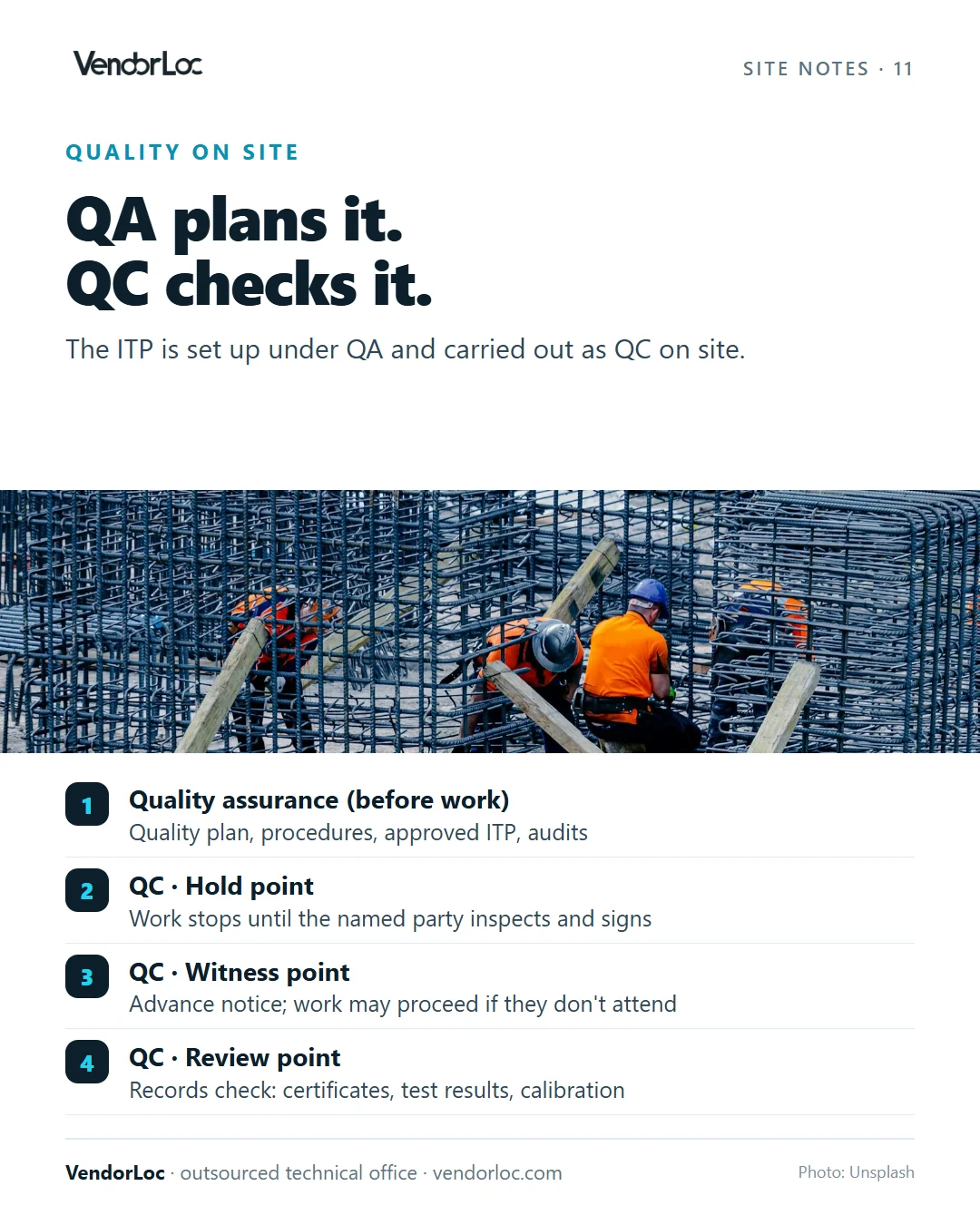
This article sets out the difference, using the definitions in ISO 9000:2015, and shows where the Inspection and Test Plan (ITP) sits between the two.
Two definitions, two questions
ISO 9000:2015 defines both terms as parts of quality management:
- Quality assurance (3.3.6): the part of quality management focused on providing confidence that quality requirements will be fulfilled.
- Quality control (3.3.7): the part of quality management focused on fulfilling quality requirements.
Put simply, QA asks "is our way of working set up so that the result will be right?" QC asks "is this piece of work actually right?" ASQ draws the same line: QA is process-focused and preventive, QC is product-focused and detects defects.
| Quality assurance | Quality control | |
|---|---|---|
| When | Before and around the work | On the work itself |
| Focus | The system and the process | The product: the element built |
| Typical outputs | Project quality plan, procedures, method statements, approved ITPs, audit reports | Inspection requests, test results, signed checklists, NCRs |
| Question | Will the requirements be met? | Have the requirements been met? |
| Failure looks like | Wrong or missing procedures, no hold points where they matter | Work covered without inspection, failed tests not closed |
The QA stage: setting up the system
QA work is mostly done before the first pour. On a typical project it covers:
- The project quality plan: who is responsible for what, which standards and specifications apply, how documents and records are controlled.
- Procedures and method statements: how each activity will be carried out, and by whom.
- The ITP itself: written by the contractor for each work package, reviewed and approved by the consultant before the activity starts. Deciding which checks are hold points, which are witness points and which are reviews is a QA decision.
- Audits: periodic checks that the system is being followed, such as whether inspection requests are raised on time, whether calibration certificates are current and whether NCRs are closed.
If QA is weak, QC cannot save the project. An inspector can only check what the plan tells them to check, at the time the plan tells them to check it.
The QC stage: checking the work through the ITP
QC is the day-to-day verification on site. The approved ITP turns into a sequence of inspection points, each with an acceptance criterion, a reference document and a named party who signs. Three types of point appear in most construction ITPs.
Hold point
Work stops until the named party has inspected and signed. Hold points belong where a defect would be covered up or become very costly to fix: reinforcement before concrete is placed, waterproofing before backfill, embedded services before a slab is poured. The contractor cannot proceed past a hold point on their own authority.
Witness point
The contractor gives advance notice so the consultant or client can attend. If they do not attend within the agreed notice period, work may proceed and the inspection record is still completed and kept. Witness points suit checks that matter but can be verified later if needed, such as a pressure test or a sample installation.
Review point
A records check rather than a site attendance: material certificates, mill test reports, laboratory results, calibration records or survey data are reviewed against the specification. Review points often sit before a hold point, so the inspector arrives knowing the materials are compliant.
How the two stages connect
The link between QA and QC is the feedback loop.
- QA sets the plan: the ITP, its points and its acceptance criteria.
- QC runs the plan on site and records the results.
- QC findings, such as repeated NCRs on the same activity, go back to QA.
- QA changes the system: a revised method statement, an extra hold point, more training, a different supplier.
If step 4 never happens, the site keeps finding the same defect. That is usually the sign that QA and QC have been merged into one inspection team with no one looking at the system.
A practical checklist
- Keep QA and QC as separate roles in the quality plan, even on smaller projects where one engineer covers both.
- Approve each ITP before its activity starts, and check that every activity that will be covered up has a hold point.
- State the notice period for witness points in the ITP, and record what happens when nobody attends.
- Put review points for certificates and test results ahead of the related hold point.
- Review NCR trends monthly and record the system change each one led to.
QA decides where the hold points go. QC makes sure nothing gets past them.
This article is general guidance. Project contracts, specifications and the employer's quality requirements take priority.
Sources
- ISO TC 176/SC 1, Terms in ISO/TC 176 standards (ISO 9000:2015 terms 3.3.6 quality assurance, 3.3.7 quality control)
- ASQ, Quality assurance vs quality control
- Compliance Council, Inspection and test plans in construction quality management
- Visibuild, What is an ITP in construction
- VariationFlow, How to write an ITP